
This post may contain affiliate links. Please read our disclosure policy.

Reading and implementing what I learned from the book Mindless Eating was a real turning point in my weight loss journey.
It was the tipping point that led to achieving the peace with food I’d been seeking while maintaining the Weight Watchers goal weight I’d set back in my late 20s.
Table of Contents
- 6-Week Mindless Eating Challenge Background
- 6-Week Mindless Eating Challenge Schedule
- Week #1: My Notes and Thoughts on Mindless Eating: Why We Eat More Than We Think Chapters 1 and 2
- Notes from the Introduction Of Mindless Eating: Why We Eat More Than We Think
- Video Discussing Mindless Eating Chapters 1 & 2
- Notes from Chapter 1 of the Book Mindless Eating: Why We Eat More Than We Think
- Notes from Chapter 2 of Mindless Eating: Why We Eat More Than We Think
- More Articles, Tips & Hints for WeightWatchers
6-Week Mindless Eating Challenge Background
Now more than a decade later, as I settle in at the scene of this healthy exploration (Land O’ Lakes, WI), I thought it would be fun to create a 6-week Mindless Eating Challenge to help others experience what I discovered.
While Weight Watchers friendly recipes are important, they are only one part of the equation. Learning how to manage our environment and develop healthy habits are the critical elements of lasting weight loss success.
Mindless Eating: Why We Eat More Than We Think (affiliate link) helped me see this.
But it’s not enough to just read a book. You have to practice what you discover. Which is what this challenge is all about.
“I hear and I forget. I see and I remember.
I do and I understand.”
~ Confucius
For this challenge, we will all read Mindless Eating: Why We Eat More Than We Think (affiliate link) and share our awarenesses and experiences. Every week for six weeks, from July 10 – August 14, we’ll read two chapters a week and share what we learn.
I’ll kick things off every Monday with a post, which will give provide participants a place to comment with their discoveries, if they’d like.
It seems like a perfect summer project: A virtual book club, but with homework 🙂
To be most effective, this challenge is best undertaken in a low key “let’s just see what we discover” manner. No pressure. No way to fail.
But it does provide a bit of accountability if you find it helpful in propelling you into action.
All you need to do to take part is buy the book Mindless Eating: Why We Eat More Than We Think (or borrow it from your library).
Here’s the basic schedule:
6-Week Mindless Eating Challenge Schedule
- Why I’m Doing This 6-Week Mindless Eating Challenge
- Mindless Eating Challenge Kick-Off
- Week #1: July 10 – Chapters 1 and 2
- Week #2: July 17 – Chapters 3 and 4
- Week #3: July 24 – Chapter 5 and 6
- Week #4: July 31- Chapters 7 and 8
- Week #5: August 7- Chapters 9 and 10
- Week #6: August 14 – Appendix B and Wrap-Up
Week #1: My Notes and Thoughts on Mindless Eating: Why We Eat More Than We Think Chapters 1 and 2
The Bottom Line: There’s nothing wrong with you. We were designed for the “see food” diet. It’s natural to eat food that we see and that is readily available. This made sense in a world where food was sometimes plentiful and sometimes scarce. The problem is that today food is TOO PLENTIFUL (for those who struggle with our weight, anyway).
You need to learn to set up an environment that supports your desire to eat better and lose weight. This is your work. You will need to practice for a while. Breaking old habits and forming new ones takes time, but it is worth it!
Weight Loss Strategies:
- Think 20% more or less. Dish up 20% less than you think you want. Increase fruits and veg by 20% to make up for the difference.
- Pre-plate your food. Avoid serving anything except fruits and vegetables family style.
- Avoid seconds. Wait at least 20 minutes before eating more. Gives time for stomach and brain to know you are full.
- Don’t eat directly from boxes, bags, containers, packages. Portion out your food and put it in a dish.

Notes from the Introduction Of Mindless Eating: Why We Eat More Than We Think
- Everyone of us eats how much we eat largely because of what’s around us.
- Most of us are blissfully unaware of what influences how much we eat.
- We think we are too smart to be tricked by things like packages, plates and lighting. That’s what makes it so dangerous!
- This approach is not about dietary extremism.
- You can re-engineer your environment so you can eat what you want without guilt and without gaining weight.
- Food is a great pleasure.
- We need to shift our surroundings to work with our lifestyle instead of against it.
- You need to remove the environmental cues that lead to overeating.
- You need to redesign your kitchens and habits.
- The best diet is the one you don’t know you are on.
Video Discussing Mindless Eating Chapters 1 & 2
Notes from Chapter 1 of the Book Mindless Eating: Why We Eat More Than We Think
- People eat more when given a bigger container. Even when they are not hungry and/or the food doesn’t even taste good!
- The “Popcorn Experiment” shows how frail willpower is. People served a large popcorn bucket ate 173 more calories (53% more) than those given a medium container, even though the popcorn was stale and many folks had just eaten lunch so they weren’t hungry.
- Our body fights against them. We are designed for survival in a feast or famine world. This design works against us in our modern all-you-can eat world where food is too plentiful, but our instincts are still programmed to eat as much as we can as often as we can.
- Our brain fights against them. If we consciously deny ourselves something we are likely to end up craving it more and unlikely to stick with it.
- Our day to day environment fights against them. We are bombarded my sights and smells encouraging us to eat. Fast food, convenience stores, vending machines, television commercials all signaling us to eat.
- The “Mindless Margin” is a calorie range that we are unaware of. If we eat way too much or way too little we know it. But small differences of a couple hundred calories don’t register with our bodies or minds. They are too small to notice. These little differences repeated day after day can cause us to slowly gain or lose weight.
- Cutting just 100 calories/day: would prevent weight gain in most of the US population. (Classic article published in the journal Science.) Click here for some easy ways to cut 100 calories/day.
- Divide calories/10: to determine how much weight lost in a year by cutting out a number of calories per day. For example: if you eliminate 150 calories a day at the end of the year you will be 15 pounds lighter! If you cut out 250 calories a day, at the end of the year you will be 25 pounds lighter!
- Easy weight loss strategy: Trim 100-200 calories/day in a way that doesn’t make you feel deprived and you will slowly and steadily lose weight without pain or suffering! Click here for some easy ways to cut 100 calories/day.
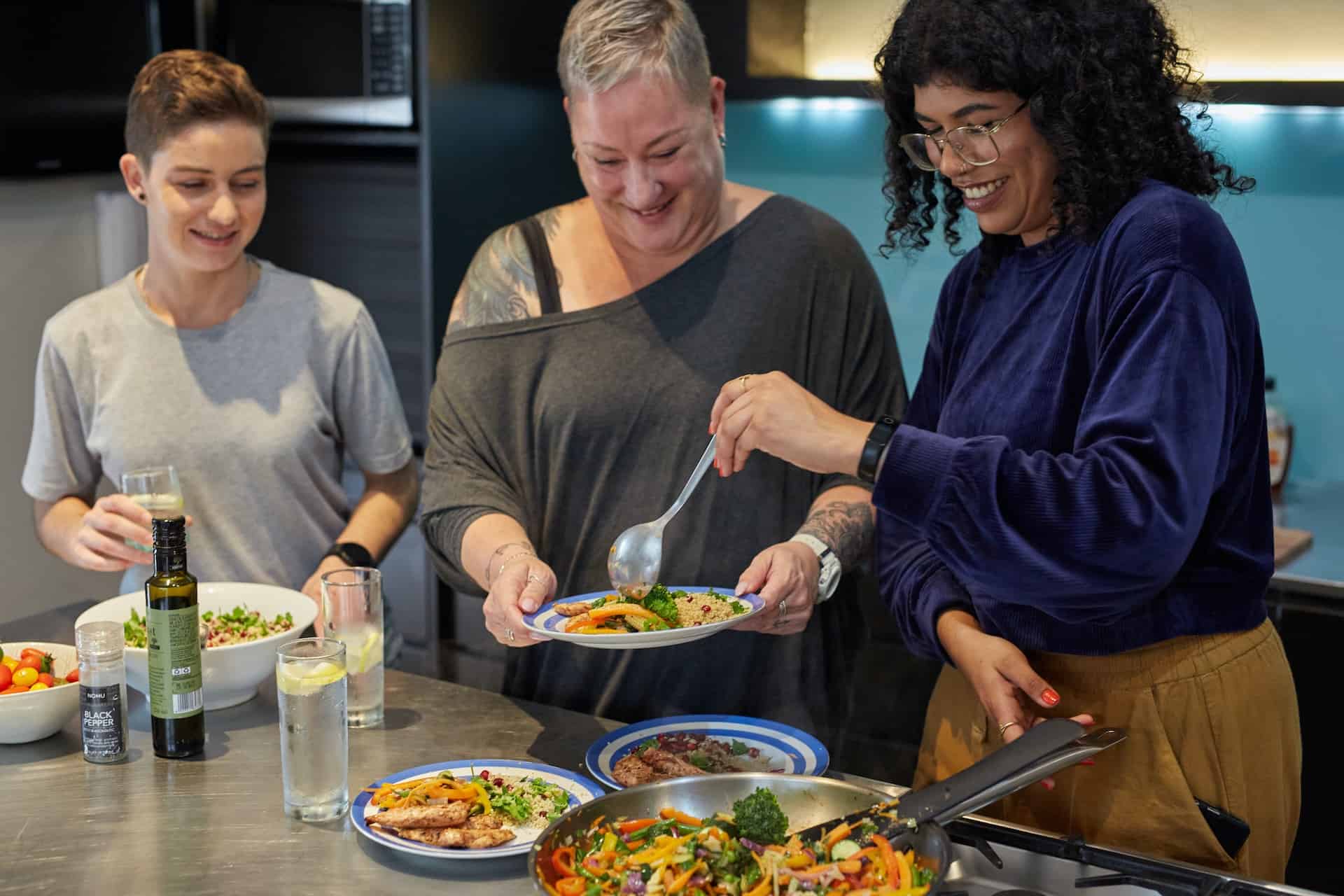
- Focus more on HOW MUCH you eat rather than what you eat.
Notes from Chapter 2 of Mindless Eating: Why We Eat More Than We Think
- We all suffer from food amnesia. We are not designed to accurately track what we have eaten.
- We need external benchmarks to tell that we are gaining weight or losing weight:
- fit of our jeans
- notch of our belt
- energy level walking up stairs
- We believe our eyes, not our stomaches. Research shows that people get full by the amount of food they eat, not the number of calories they take in. You can cut calories in your favorite foods by lowering the amount of fat and or increasing the amount of fiber-rich ingredients, such as vegetables or fruit.Click here for more ideas on how to lighten up your recipes so you can eat the same amount of food, but with fewer calories.
- We are terrible estimating the number of calories we eat. Normal weight people underestimate by about 20% Obese people underestimate by 30-50%.
- The bigger the meal the more we will underestimate its calories.
Questions to Consider:
- What were your biggest takeaways from Chapters 1 and 2 of Mindless Eating?
- What strategies have you implemented? What have you discovered?
- What surprised you most about the North Dakota wine study?
- Do you agree that volume trumps calories and our stomachs are bad at math?
- What is your typical cue to stop eating? Do you usually finish everything on your plate? Why or why not?
I’ll be back next week with my notes from Chapters 3 and 4.
Have a great week!
Warmly,
Martha
More Articles, Tips & Hints for WeightWatchers
- A Comprehensive Guide to Understanding the WeightWatchers Program
- A Comprehensive List of Articles & Tips for WeightWatchers
- What Foods Should I Eat in a Day on WeightWatchers
- WeightWatchers Zero Points Foods List
- WeightWatchers Friendly Meal Plans
- Why We Are More Motivated the Closer We Get to Our Goals – Another powerful WW Weekly Workshop Topic.



I am hopeful I will find many good take-aways from this book. I know I eat more volume than I should. I don’t always stop eating when I feel full. My trigger foods beckon me to want more of the flavor so I overindulge (pasta with red sauce). I have switched to a smaller plate, am moving more during the day, and drinking more water (that one’s hard). I also think I eat dinner too late in the evening (7 p.m.) but not sure if this is my worst problem.
The biggest eye opener for me was the stale popcorn experiment. I really thought about all
those times I have eaten things that don’t taste good but were given to me as a gift, or I ordered it at a restaurant, or I bought it and someone has to eat it so it isn’t wasted or because I didn’t want to hurt someone’s feelings. Thank you for doing this book study; I look forward to learning and sharing!
Hi Mary, I’ve been guilty of that too! Now, I try to remember to always ask, “Is it worth the points/calories?” Often I realize it’s not!!
I have had my eyes widened. His studies make a lot of sense and I do see where food has always been ample in my home environment. I have bought big bags and made them smaller bags dividing things up so I don’t indulge myself. I have bought fruit and vegetables that are in season in my area this week to help with the hunger issues.
Karen, I know what you mean about having your eyes widened. Once you read this book, I don’t think you ever look at food and your environment the same again!! Love that you are portioning out items into smaller bags from the big ones and stocking up on in season fruits and veg! Way to go!!
I just got the book from the library. I may have to read ahead because I won’t have it for more than a few weeks. Thanks for the encouragement.
Absolutely, read ahead Joanie! I hope it helps you as much as it has me 🙂
Perhaps use the other system of WW which many seemed to like, and ditch the SmartPoints? I only ever did the version before the ProPoints or whatever they were called. In the old days, you had 20 points, and that was it. You could drink 20 glasses of wine at 1 point per glass and still lose weight but it wasn’t very healthy if you did!!! You have to lose weight if you eat less and choose wisely. And 30 points can go a long way if you choose something that’s both filling and life-giving, not a cream doughnut or slices of bread and butter or plates of pasta. Lean protein is sustaining. I have porridge every morning, and have done for years but now I make it with water instead of skimmed milk, and it saves points, and quite honestly doesn’t taste that much different. If it’s any consolation, I won’t be reading the book. Enough to read here!! By the time it would arrive in England from America, I’m hoping I’d have lost half a stone at least out of my 18 lbs I need to lose! Good luck!
Thanks for sharing Una!
I think the environment in which you are eating a meal plays into how much you eat and the enjoyment of it. For example, I often really enjoy a wine we choose when out at a nice restaurant, only to buy it later and think it is just so-so when drinking it at home.
One of the most difficult things for me to enjoy while on WW (I lost 35 lbs; it took a year because of some metabolic issues I have, but I’m at goal) is eating out at a restaurant. Their low-calorie items are tasteless. I enjoy cooking and therefore want something good to eat when going out–something I probably wouldn’t make at home.
I don’t want to sound negative, and I hope to learn changes from this book. But I cannot maintain my hard-won eating more than 30 smart points (I could only lose on 25-27 SP) and don’t see how I could shave 100-200 without noticing it!
Get your take home box before you eat. Order what you really want and portion it!
Hi Cyndy, clearly everyone is different. I agree that restaurant eating can be challenging. I recently spent 4 days on the road traveling from Arizona to Wisconsin and ate out much more than normal. I allowed myself to order pretty much anything I wanted. My husband and I both discovered how terrible we felt in the morning after eating at Olive Garden. We felt puffy and foggy headed, like we had a food hangover. I never wake up feeling like that when I cook at home. I’m wondering what caused the reaction? Too much salt? Too much fat? What was in the food to cause such a feeling? Try to take the attitude that what you are doing is just a game that you are playing that you can quit whenever you want! I really helps me.
One “trick” I have used in the last year is to go out to lunch instead of dinner. It seems like it’s easier to eat something interesting but not too fatty/salty. Many times I will get fruit with whatever I order, eat the fruit and half of the order (ex: half a BLT) and bring the other half home for dinner.
But cooking at home has been much more satisfying, due to all the WW recipes from you and others.
I hope to learn new “tricks” from the book. Thanks for doing this; it’s enlightening to read others’ comments.
Volume definitely trumps calories for me. I learned from WWs to bulk up my sandwiches with vegetables, and it’s much more satisfying than just a meat and bread sandwich!
From the reading we did, I was surprised by the notion that we feel full/satiated only after we clean our plate. It never dawned on me before that I do that! I’m looking forward to figuring out how to eat 20% less…..I’m worried I will perceive it as a deprivation. Smaller plate = less food. Less food on standard plate = less food, too.
Hmmmmm….how to do the 20% less thing?…..
-SA
Hi SA, I’ve learned through the years that volume trumps calories for me too. I’ve learned to bulk up lots of different meal with plenty of low calories vegetables. I’d suggest keeping an open mind with using smaller plates and eating 20% less. Tell yourself you can have more later if you are really hungry. That’s what I do and surprise – I rarely am 🙂
Pick a smaller plate. That might help.
I use a smaller plate and don’t feel deprived at all. As a volume eater I still get a full plate. I also try to fill at least 75% of my plate with natural high fiber foods. They take longer to eat and keep me satisfied so I snack less.
Just ordered the book! Seems pretty interesting!
I am overwhelmed by my failures at “dieting”. My little inner voice says, “why try, you know you will just fail.” Working at staying positive with myself and moving into more healthy eating. Thanks for a good read suggestion, recipe suggestions and encouragement.
Hi Joy, sounds like it’s time to tell your inner mean girl to shut up! You are not failing. Always remember that trying + failing = learning!!
My favorite part so far is the story about one of his friends who was eating when he was not hungry, which is one of the problems I face. The friend started to say OUT LOUD, I am not hungry but I am going to eat __ (this food thing) anyway. I have tried that and I felt so ridiculous that when I say it I usually end up not eating anything. I have been practicing eating 80 % of what is on my plate. That is working great because I can eat the rest of what is on my plate a bit later if I am still hungry.
Thanks for the great idea of working through this book together!!
Jill, I loved that part too! After reading this, I realized I had the habit of dipping into the jar
of nuts when I stepped into the pantry each morning to grab my dog her dogfood! It had nothing to do
with hunger, just a reaction from seeing the jar. I now regularly tell myself to step away from the nuts.
Self talk can seem crazy, but it snaps us out of the unconscious coma that results in so much mindless eating!