
This post may contain affiliate links. Please read our disclosure policy.
Reading and implementing what I learned from the book Mindless Eating by Brian Wansink was a real turning point in my weight loss journey.
It was the tipping point that led to achieving the peace with food I’d been seeking while maintaining the Weight Watchers goal weight I’d set back in my late 20s.
�»)Table of Contents
- 6-Week Mindless Eating Challenge Background
- 6-Week Mindless Eating Challenge Schedule
- Week #3: My Notes & Thoughts on Mindless Eating: Why We Eat More Than We Think Chapters 5 & 6
- Mindless Eating Scripts
- All You Can Eat Television
- Meal Multitasking
- Mindless Eating Restaurant Strategies
- The Power of Smells & Tastes & Food Preferences
- Chapter 6 Mindless Eating Notes
- Questions to Consider:
- More Articles, Tips & Hints for WeightWatchers
6-Week Mindless Eating Challenge Background
Now seven years later, as I settle in at the scene of this healthy exploration (Land O’ Lakes, WI), I thought it would be fun to create a 6-week Mindless Eating Challenge to help others experience what I discovered.
While Weight Watchers friendly recipes are important, they are only one part of the equation. Learning how to manage our environment and develop healthy habits are the critical elements of lasting weight loss success.
Mindless Eating: Why We Eat More Than We Think (affiliate link) helped me see this.
But it’s not enough to just read a book. You have to practice what you discover. Which is what this challenge is all about.
“I hear and I forget. I see and I remember. I do and I understand.”
~ Confucius
For this challenge, we will all read Mindless Eating and share our awarenesses and experiences. Every week for six weeks, from July 10 – August 14, we’ll read two chapters a week and share what we learn.
I’ll kick things off every Monday with a post, which will give provide participants a place to comment with their discoveries, if they’d like.
It seems like a perfect summer project: A virtual book club, but with homework 🙂
To be most effective, this challenge is best undertaken in a low key “let’s just see what we discover” manner. No pressure. And no way to fail.
But it does provide a bit of accountability, if you find it helpful in propelling you into action.
All you need to do to take part is buy the book Mindless Eating: Why We Eat More Than We Think (affiliate link), by Brian Wansink (or borrow it from your library).
Here’s the basic schedule:
6-Week Mindless Eating Challenge Schedule
- Why Try This 6-Week Mindless Eating Challenge?
- Mindless Eating Challenge Kick-Off
- Week #1: July 10 – Chapters 1 & 2
- Week #2: July 17 – Chapters 3 & 4
- Week #3: July 24 – Chapter 5 & 6
- Week #4: July 31 – Chapters 7 & 8
- Week #5: August 7 – Chapters 9 & 10
- Week #6: August 14 – Appendix B & Wrap-Up
Week #3: My Notes & Thoughts on Mindless Eating: Why We Eat More Than We Think Chapters 5 & 6
The Bottom Line:
- Our eating patterns are based on deeply ingrained habits that are often unconscious. They are like movie scripts that we follow without thinking.
- It’s possible to change these scripts to support our weight loss goals.
- The longer we stay at the table the more we eat.
- We tend to eat more in the company of others than we do alone.
- People who watch a lot of tv are more likely to be overweight than the people who don’t.
- Distractions of all kinds while eating make us eat more, make us forget how much we eat and extend how long we eat – even when we are not hungry.
- Our thoughts and beliefs about food have a powerful effect on our taste buds.
- Smells can be very powerful thus the “Cinnabon Effect”
Mindless Eating Weight Loss Strategies:
- At meal time try to be the last person to start eating, pace yourself with the slowest eater.
- Always leave a little food on your plate so people aren’t encouraging you to eat more.
- Pre-determine what you will eat by deciding how much to eat before the meal, instead of during it.
- Eat with other weight conscious friends, not the all-you-can-eat crowd whenever you can.
- Turn off the tv during meal times or portion out your food ahead of time
- Avoid doing other things – driving, checking email, reading, etc – while eating
- Rescript your eating danger zones:
- Chew gum instead of snacking after work and while you are getting dinner ready.
- At breakfast eat and then read the paper or check email, don’t do them at the same time.
In Restaurants:
- Send away the bread basket or place it out of reach
- Share an entree or have half packed to go
- Order 2 appetizers instead of an entree
- Share dessert – the best part is the first two bites
- Establish a Pick 2 Rule – appetizer, drink, dessert (not all three)
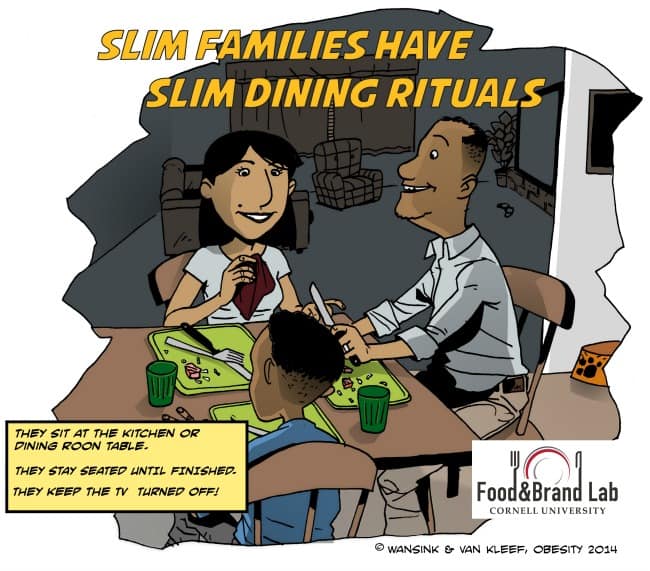
Image Source: Cornell University Food & Brand Lab
Mindless Eating Scripts
Many of our patterns of eating are deeply ingrained habits that we are often unconscious of. We do them without even thinking. They are like movie scripts that we follow day in and day out…
- Breakfast: Open the paper and fill the cereal bowl and proceed to eat until finished with the paper.
- Dinner: Finish eating what’s on the plate and take additional food helpings until everyone else is done.
- Snack: Find the cable movie to watch and make popcorn.
Our scripts usually cue us when to stop eating, rather than our sensation of being full. For example, we stop eating when we run out of time, the tv show is finished, when we are done reading or when the food is gone. We are usually completely disconnected to what we are feeling.
I realized I was in the habit of grabbing a few nuts when I opened the pantry to feed the dog. This had nothing to do with hunger. It was just a reflex.
It’s possible to change our scripts to support our weight loss goals.
Family, Friends & Fat
One of life’s pleasures is eating with friends and family. However, they strongly influence what we eat.
Eating is like shopping, the longer you stay at the mall, the more you buy. The longer you stay at the table, the more you eat.
If you eat with one other person, you’ll tend to eat 35% more than you would otherwise. If you eat with three other people, you’ll eat 75% more calories. If you eat with seven or more people, you’ll eat 96% more.
Birds of a feather flock together, which is why couples and families tend to be of similar sizes. Weight gain can be contagious!

All You Can Eat Television
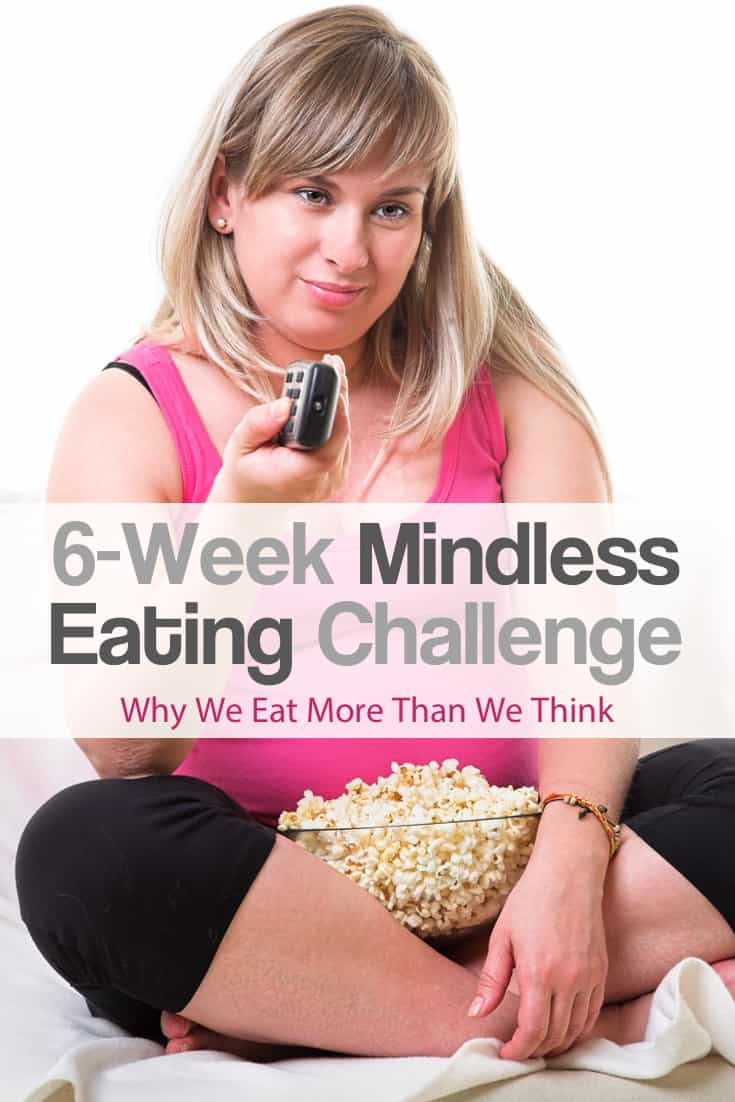
People who watch a lot of television are more likely to be overweight that people who don’t. The less tv people watch the skinnier they are. Television is a triple eating threat: It leads you to eat, leads you to not pat attention to how much you eat, leads you to eat for too long.
Meal Multitasking
Eating while engaging in other activities is dangerous to the waistline.
- 91% of people watch tv while eating meals at home
- 62% are often or too busy to sit down and eat
- 35% eat at their desk while they work
- 26% eat while driving
Anything that takes your focus off the food while eating makes us more likely to overeat without knowing it.
Mindless Eating Restaurant Strategies
- Send away the bread basket or place it out of reach
- Share an entree or have half packed to go
- Order 2 appetizers instead of an entree
- Share dessert – the best part is the first two bites
- Establish a Pick 2 Rule – appetizer, drink, dessert (not all three)
The Power of Smells & Tastes & Food Preferences
Marketing is about positive association and memory. Smell is hardwired to memory. Thus the power of the “Cinnabon Effect.” Hold your nose while eating something you really like and notice that it doesn’t taste as good.

Chapter 6 Mindless Eating Notes
Our thoughts and beliefs about food affect our taste buds.
People who were told they were eating strawberry yogurt in the dark believed it and rated the flavor as “good strawberry taste” when they were actually eating chocolate yogurt. People given lemon jello colored red thought it was cherry. Except in extreme cases the research confirms that we taste what we think we will taste.
We are very influenced by the names given to foods on menus. Descriptive names sell better and are perceived as tasting better.
Food served in a nice setting is perceived as better. We can use this information to our advantage if we want to be perceived as better cooks. Take some time to dim the lights, play soft music, use nice glasses and dishes, add flowers and candles.
I think this could also work to our advantage when trying to get our families to eat healthier. If you don’t tell them it’s healthy or Weight Watchers or low calorie, they probably won’t know it!
Questions to Consider:
- What were your biggest takeaways from Chapters 5 & 6 of Mindless Eating?
(I had no idea how much more we eat when we are with others.) - What are some of your mindless eating scripts?
(Mine include: grabbing a few nuts whenever I step into the pantry and tasting too much when cooking) - What strategies have you implemented? What have you discovered?
(I’ve gotten out of the habit of eating while watching television, reading or working at the computer. It took time but was worth it.) - Are you curious about doing more blind taste testings after reading about the studies in Chapter 6?
(I’m really curious about the power of our thoughts on our perception of taste and level of satisfaction.)
I’ll be back next week with my notes from Chapters 7 & 8.
Have a great week!
PS: If you want some support eating better and losing weight this summer, my 28-Day Smart Start Weight Loss Challenge may be just what you’re looking for! Many of the tips and suggestions are based on what I learned by applying Dr. Wansink’s Mindless Eating concepts.
This has been a wonderful challenge. Thank you for all of the support and encouragement. I have definitely made some positive changes that I plan to continue! ~ Bronwyn
More Articles, Tips & Hints for WeightWatchers
- A Comprehensive Guide to Understanding the WeightWatchers Program
- A Comprehensive List of Articles & Tips for WeightWatchers
- What Foods Should I Eat in a Day on WeightWatchers
- WeightWatchers Zero Points Foods List
- WeightWatchers Friendly Meal Plans
- Why We Are More Motivated the Closer We Get to Our Goals – Another powerful WW Weekly Workshop Topic.




Great post Martha and thanks for the book recommendation,
I’m going to start reading it. It looks like it has some cool ideas.
I liked the part about eating while watching television.
It is true that sitting in front of the television for long hours
will actually slow down your metabolism, and it will be harder
for your body to burn calories.
I don’t watch TV these days, but if I do, I eat my meals first, then watch
TV. I don’t do both at the same time.
Most of our eating habits stem from the subconscious mind and if we are not fully
present in the moment at the table, then we will overeat.
Meditation has helped me in this area, to gain more awareness of
my day today activities including eating my meals.
My greatest help has been preplanning for the week. That way I know
exactly what I am eating, and if I am within my calorie limit.
Great post, and looking forward to reading the book.
P.S for anyone interested, I just read this PDF on what to do and
https://leanfitbodysecrets.lpages.co/lean-weight-loss
I found week 3 a eye opener for me. I was reminded that I h as ve a tendency to eat more while watching the TV or checking my emails while also watching. I tested this theory for 2 days and I ate less while not watching or computer and took time what to be thankful for. I also found when hanging out with friends this past week,I didnt preplan what I was going to eat and then choose something I normally wouldn’t have. I felt yucky when I got home. The last couple of weeks has taken me time to read the chapters as I had lasek eye surgery and had bandaid contact lenses over my pupils. Thank you for your amazing advice and time.
Hi Amy, I have had similar experiences eating with others or while at the computer! Thanks for sharing. – Martha